How Much to Charge for House Cleaning (Per Hour, Per Square Foot & Flat Rate)
Updated October 30, 2026 · QuoteCubby
A practical guide for independent house cleaners: set an hourly rate that covers your real costs, turn it into a per-square-foot or flat price, and make sure discounts and drive time don’t quietly cut your pay.
The short answer
Charge enough that every hour you spend on the job, including the drive, pays at least your minimum. In practice:
Price = (estimated cleaning hours × your hourly rate) + supplies + travel cost − any recurring discount + add-ons, rounded up, and never below your minimum job price.
Per-hour, per-square-foot and flat-rate pricing are three ways to show the same number to a client. The hourly rate is the foundation. The other two are shortcuts built on top of it.
How much to charge per hour
Your hourly rate is not just your take-home pay. When you clean on your own, the price also has to cover:
- Taxes. Self-employed people usually pay their own payroll-type taxes. Ask a tax professional how much to set aside.
- Unpaid time: driving, walkthroughs, texting clients, buying supplies, bookkeeping.
- Costs: supplies, vacuum and tools, gas and car wear, phone, insurance or bonding if you carry it.
- Slow weeks, cancellations and time off.
A simple way to start: decide what you want to earn in a year, add your yearly costs, and divide by the hours you can realistically bill (not just work). Then look at what other independent cleaners charge locally, on community groups, local directories and review sites. If your number is far above the local range, look at your costs and speed. If it is far below, you may be underpricing.
The calculator uses two numbers: a target rate per person-hour (what you aim for) and a minimum rate (the lowest you will accept). Any job below the minimum gets a warning.
How much to charge per square foot
Per-square-foot pricing is popular because it is easy to explain. But size is only part of the work: a 1,500 sq ft home with 3 bathrooms takes longer than a 1,500 sq ft home with 1. That is why QuoteCubby estimates time from size + bedrooms + bathrooms + condition, and you can then show the result per square foot.
Here is what that looks like with the calculator’s example numbers:
| Home | Standard | Deep | Move-out |
|---|---|---|---|
| 1,000 sq ft · 2 bd / 1 ba | $120 $0.12/sq ft | $195 $0.20/sq ft | $235 $0.23/sq ft |
| 1,500 sq ft · 3 bd / 2 ba | $155 $0.10/sq ft | $270 $0.18/sq ft | $325 $0.22/sq ft |
| 2,000 sq ft · 3 bd / 2.5 ba | $175 $0.09/sq ft | $300 $0.15/sq ft | $365 $0.18/sq ft |
| 2,500 sq ft · 4 bd / 3 ba | $205 $0.08/sq ft | $360 $0.14/sq ft | $435 $0.17/sq ft |
| 3,000 sq ft · 4 bd / 3.5 ba | $225 $0.07/sq ft | $390 $0.13/sq ft | $475 $0.16/sq ft |
Example only: one-time clean, average condition, no pets, no add-ons, 12 round-trip miles, using the calculator’s starter numbers ($50 target per person-hour, $120 minimum, 45 base minutes + 15 per bedroom + 25 per bathroom + 20 per 1,000 sq ft; deep ×1.8, move-out ×2.2). These are not market rates. Put your own numbers in the calculator.
Notice how the price per square foot drops as homes get bigger. Kitchens and setup take time no matter the size. A flat per-square-foot rate tends to overcharge small homes and undercharge large ones.
Flat rate by home size
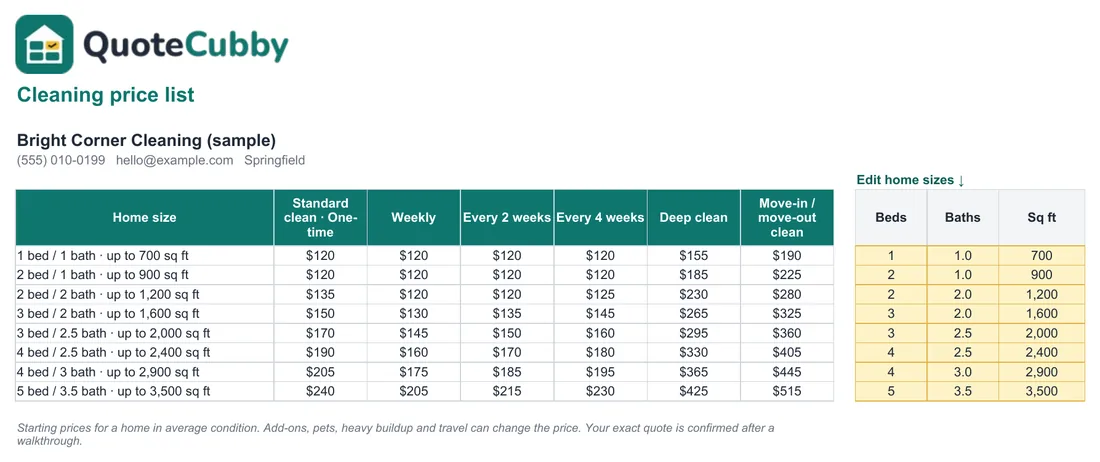
A flat price list (for example “3 bed / 2 bath up to 1,800 sq ft”) makes quoting fast and looks professional. Build it from your hourly math, not the other way around. Then use a walkthrough or photos to catch homes that need a higher condition multiplier, pets, or add-ons like inside the oven or fridge.
Recurring discounts and minimum prices
Weekly and every-2-weeks clients are valuable: steady income, less driving between new leads, and cleaner homes. A discount for recurring service is common. In the calculator the example discounts are 15% weekly, 10% every 2 weeks and 5% every 4 weeks. Yours can be different.
Two guardrails stop discounts from eating your pay:
- A minimum job price. Small apartments still cost you the drive and setup.
- A minimum hourly rate check. After the discount, does the job still pay at least your minimum per hour? If not, raise the base price or shrink the discount.
Check what you really earn per hour
This is the step most price lists skip. Take the price, subtract supplies and gas, and divide by all the person-hours, including the drive:
Real $/hr = (price − supplies − travel cost) ÷ (cleaning person-hours + drive hours)
Example from the calculator’s sample home (1,800 sq ft, 3 bed, 2 bath, a pet, every 2 weeks, inside-fridge add-on, 30 minutes of driving): the price is $190, but the real pay works out to about $42.98 per person-hour, not the $50 target. That’s still above the $35 example minimum, so it passes. Change the drive to an hour, or the discount to 20%, and see how fast it drops.
Then time your real jobs. If homes take longer than you estimated, your real hourly pay is lower than you think. The QuoteCubby Business Tracker logs estimated vs actual minutes and suggests better time estimates after 10 jobs.
Try it with your numbers
The free QuoteCubby calculator does this math for any home and tells you what you really earn per hour.
Open the free calculatorMore pricing guides
FAQ
How much should I charge per hour for house cleaning?
There is no single right number. Rates depend on your city, your costs, your experience and the services you offer. Start from what you need to earn per hour of work (after taxes, unpaid time and supplies), then compare with what other independent cleaners in your area charge. The calculator shows what a job really pays per hour.
Should I charge by the hour or by the job?
Many clients prefer a flat price because they know the cost up front. You can still use an hourly target behind the scenes: estimate the time, multiply by your rate, and quote a flat price.
What is a good price per square foot for house cleaning?
Price per square foot is a shortcut, not a rule. It changes with the number of bathrooms, the condition of the home and the type of clean. Work it out from your own hourly rate and timing, as in the table above.
Should I charge less for recurring cleanings?
A recurring discount is common because regular homes stay cleaner and are faster. Check that the discounted price still pays at least your minimum per hour, including drive time.